Apartments and independent houses differ in a way most Indian buyers don’t fully grasp until they’re deep into the decision: an apartment owner doesn’t own zero land, as many assume — they hold an undivided share of the total plot, proportional to their unit’s size, just spread so thin across every other owner in the building that it barely registers compared to owning a full plot outright. That single structural difference is what quietly drives nearly every other distinction between the two — appreciation, resale value, maintenance, and even how the legal due diligence process works.
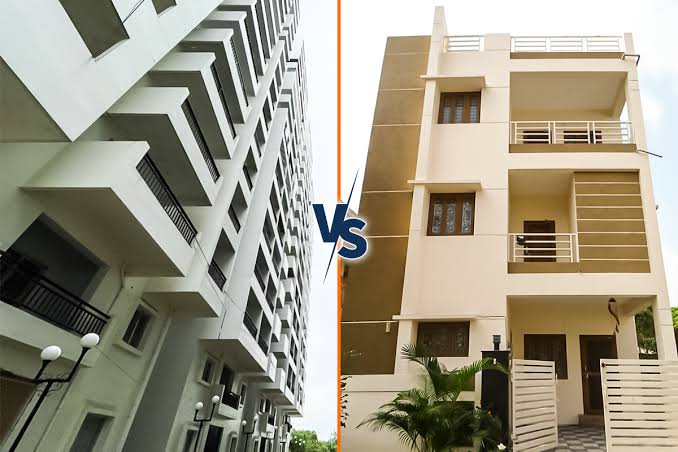
The Core Legal Difference: Land Ownership Structure
Before comparing costs or lifestyle, it’s worth understanding the underlying ownership mechanics that everything else flows from.
- An independent house gives you complete, direct ownership of both the land and the structure built on it
- An apartment gives you full ownership of your specific unit, plus an undivided share in the total land the building sits on, proportional to your unit’s size relative to the whole project
- This distinction matters because land, as a finite resource, tends to appreciate over time, while a physical structure — whether a standalone house or an apartment building — depreciates as it ages
- Because an independent house’s value is anchored more heavily in land you own outright, its long-term appreciation trajectory tends to differ meaningfully from an apartment’s, where the land component is diluted across dozens or hundreds of owners
Cost Comparison: Why Houses Cost More Per Square Foot
The price gap between these two property types reflects exactly what you’re paying for underneath the square footage figure.
- In most Indian cities, flats typically range between ₹5,000 and ₹15,000+ per square foot, while independent houses often run ₹8,000 to ₹25,000+ per square foot
- This gap exists because independent house buyers pay for both land and construction separately, while apartment buyers pay primarily for built-up space and a share of common infrastructure
- Construction costs for a house also rise with any customization, since a standalone home gives you far more design freedom than a standardized apartment layout, and that freedom comes at a price
- The cost of buying land and building on it will generally always exceed the cost of an equivalent apartment in the same neighborhood, purely because of this added land component
Appreciation: Land vs Structure
This is where the ownership distinction translates directly into long-term financial outcomes.
- Independent houses generally appreciate more over time specifically because land value tends to rise, particularly in areas with strong infrastructure growth, while the apartment building itself is a depreciating asset
- Land-linked properties in fast-developing corridors have historically seen some of the sharpest price gains, precisely because land itself is scarce and increasingly limited in supply as cities grow
- Modern apartments in genuinely premium, well-connected locations can still deliver healthy returns, though the appreciation curve tends to be gentler than a comparable independent house in a similar growth corridor
- This doesn’t make apartments a poor investment — it simply means the two property types generate returns through different mechanisms, land appreciation for houses versus a combination of location demand and unit-level premium for apartments
Maintenance: Predictable Charges vs Variable Responsibility
This is one of the most practically significant differences for day-to-day ownership, and it’s often underweighted compared to the more headline-grabbing appreciation comparison.
- Apartments come with a predictable monthly maintenance charge covering shared facilities, security, landscaping, and often major structural repairs handled collectively through the housing society
- Independent houses instead carry variable costs — a mix of small, routine expenses alongside occasional large, irregular repairs like roof work, plumbing overhauls, or structural maintenance, all of which fall entirely on the owner to manage and fund
- This unpredictability can make independent house ownership genuinely more time-consuming and, over certain years, more expensive than the steady monthly apartment maintenance figure suggests on paper
- Independent houses may also require additional security investment — cameras, alarms, or a dedicated guard — that apartment living typically includes as part of the shared society infrastructure
Liquidity and Resale Speed
When it comes time to sell, these two property types face genuinely different market dynamics.
- Apartments generally offer greater liquidity and faster resale, since demand for well-maintained units in established buildings tends to be steadier and broader than the buyer pool for any specific independent house
- Independent houses often face longer buying cycles and more limited supply-demand matching, since a buyer needs to specifically want that plot’s size, layout, and location, narrowing the realistic buyer pool considerably compared to a standardized apartment
- This liquidity difference matters enormously for anyone who might need to sell within a shorter timeframe — an apartment is generally the safer choice if flexibility to exit quickly matters to your financial plan
- For buyers with a genuinely long-term horizon, this liquidity gap matters less, since they’re not planning to test the resale market anytime soon regardless of which property type they choose
Rental Income: A Closer Comparison Than You’d Expect
This is a place where common assumptions don’t quite match the actual data.
- Rental yields for both apartments and independent houses run fairly close, typically in the 2.5-3.5% range annually across top Indian cities, despite the meaningfully different price points and perceived prestige of each property type
- Vacancy periods tend to be shorter for apartments, since there’s consistent tenant demand for a well-maintained unit in a good location, while renting out a full independent house can involve more downtime between tenants
- This means the “bigger, more expensive house” doesn’t automatically translate into proportionally better rental returns — the yield percentage stays roughly similar even as the absolute property value differs significantly
- For an investor specifically prioritizing rental income over appreciation, this near-parity in yield, combined with apartments’ shorter vacancy periods, is worth weighing seriously against the common assumption that houses are the superior investment across every dimension
Legal Verification: What Changes During Due Diligence
The due diligence process itself differs meaningfully between these two property types, reflecting their underlying ownership structures.
- Apartment purchases primarily require verifying the specific unit’s documents alongside the broader society’s records — RERA registration, occupancy certificate, and society formation documents
- Independent house purchases require all of this plus a considerably deeper land verification process — a clear land title, chain of ownership documents, approved building plans, and plot records specific to that piece of land
- This added complexity means independent house buyers generally need more thorough, often more expensive, legal due diligence before finalizing a purchase compared to a standard apartment transaction
- Given how much of an independent house’s long-term value depends specifically on clean land title, skipping or rushing this verification carries meaningfully higher risk than the equivalent shortcut on an apartment purchase
Which Fits Which Kind of Buyer
Bringing these differences together into a practical framework for choosing between the two.
- Choose an apartment if your priority is convenience, a predictable monthly budget, faster resale flexibility, and lower ongoing decision fatigue around maintenance
- Choose an independent house if you specifically value land ownership, more space and privacy, complete design freedom, and have a genuinely long holding horizon — commonly cited as 15 years or more
- Larger, joint families often find independent houses better suited to their space and privacy needs, while nuclear families frequently find apartments’ combination of convenience and community amenities a better everyday fit
- Regardless of which type you choose, keeping your total housing cost — purchase price, registration, loan interest, maintenance, and property tax combined — within roughly 30-40% of your monthly household income remains a sound guideline for either path
This is general educational information comparing apartments and independent houses in India, not investment or legal advice. Prices, appreciation trends, and regulatory requirements vary significantly by city and specific location, and independent due diligence and professional guidance are essential before making a purchase decision.
FAQs
Q1. Do apartment owners actually own any land, or just the building unit?
A: Apartment owners hold an undivided share of the total land the building sits on, proportional to their unit’s size — it’s real ownership, just spread thin across every unit owner rather than held outright like an independent house.
Q2. Is an independent house always a better investment than an apartment?
A: Not necessarily. While houses generally appreciate more due to land value, apartments offer better liquidity, faster resale, and shorter rental vacancy periods, with rental yields for both types actually running fairly close at 2.5-3.5% annually.
Q3. Why does legal due diligence take longer for an independent house than an apartment?
A: Independent houses require verifying clear land title, chain of ownership, and plot-specific approvals in addition to standard property documents, while apartments primarily need unit and society-level verification, making house due diligence meaningfully more involved.
Q4. Which option makes more sense for someone who might need to sell within five years?
A: An apartment is generally the safer choice for a shorter holding period, since it typically offers faster resale and a broader buyer pool compared to an independent house, which often faces a longer, more limited buying cycle.