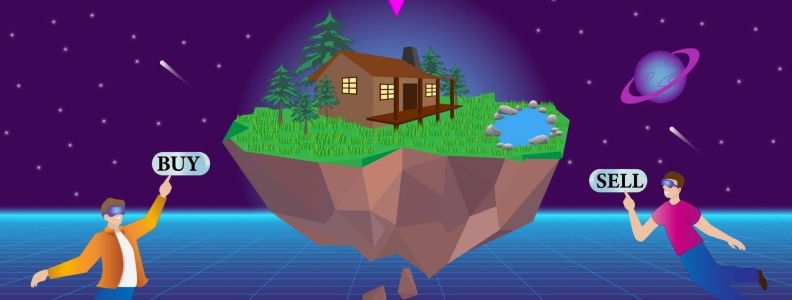
Virtual land in blockchain metaverses works essentially like real estate ownership recorded on a blockchain instead of a government land registry — you buy a specific plot within a virtual world, receive an NFT proving you own it, and gain the right to build, rent, or resell whatever sits on that coordinate. The mechanics are genuinely straightforward. What’s changed dramatically since the concept first captured mainstream attention is the price reality surrounding it.
| Quick Facts | Details |
| Ownership mechanism | An NFT (typically ERC-721) representing a specific coordinate or parcel |
| Major platforms | Decentraland (~90,000-98,000 LAND parcels), The Sandbox, Otherside |
| Decentraland parcel size | 16m x 16m per LAND NFT, on Ethereum |
| Average metaverse land price decline from 2022 peak (by mid-2024) | Roughly 72% overall, with individual platforms down 85-95% |
| 2025 global metaverse land market size | Roughly $4.12 billion, down sharply from earlier projections |
| Governance model (Decentraland) | Token holders vote on platform policy through a DAO structure |
Here’s a number that captures just how dramatically this market has changed: a metaverse land plot purchased during the 2021-2022 boom for approximately $24 million had collapsed in value to roughly $9,000 by early 2026, based on current collection floor prices. That’s not an isolated anecdote — CoinGecko’s research found average metaverse land prices down about 72% from their peak by mid-2024, with individual platforms faring even worse: The Sandbox down roughly 95%, Decentraland down roughly 89%, and Otherdeed for Otherside down roughly 85% from their boom-era floor levels.
What “Virtual Land” Actually Is
Before evaluating the market, it’s worth understanding precisely what you’re buying.
- Virtual land is a specific coordinate or parcel within a blockchain-based virtual world, represented on-chain as an NFT
- That NFT proves ownership and grants rights to build on, modify, or monetize that specific space within the platform’s rules
- Ownership is recorded permanently on the blockchain, independent of the platform’s own servers, though the actual experience of “visiting” that land still depends on the platform’s software running
- Unlike physical real estate, virtual land has no inherent scarcity beyond whatever limit the platform’s creators programmed into its total supply
- Most platforms fix a finite total number of parcels at launch — Decentraland, for instance, maintains roughly 90,000-98,000 LAND NFTs, a number that doesn’t expand over time
How Major Metaverse Platforms Structure Land
Different platforms take meaningfully different approaches to how land ownership functions within their worlds.
- Decentraland operates as a fully decentralized virtual world with land governed through a DAO, where MANA token holders vote on platform policies and development priorities
- The Sandbox takes a more gaming-focused approach, emphasizing creator tools and brand partnerships, with land tied to its SAND token economy
- Otherside, developed by Yuga Labs (the team behind Bored Ape Yacht Club), positions itself around a broader gaming and interoperability vision, though it faced some of the steepest price declines of the major platforms
- Each platform’s land exists as a separate, platform-specific asset — currently, there’s no meaningful interoperability letting you move land or an avatar between these different virtual worlds
What You Can Actually Do With Virtual Land
Ownership itself is only the starting point — the actual utility comes from what you build or do with that space.
- Build interactive experiences, games, or virtual storefronts using platform-provided creator tools like Decentraland’s Builder or The Sandbox’s VoxEdit
- Host events — virtual concerts, product launches, or brand activations — sometimes for paying clients
- Rent your land to other creators or brands looking for temporary space within the world
- Resell the land NFT itself on secondary marketplaces, subject to whatever current market demand exists
- Design and sell wearable digital items (NFT clothing, accessories) that avatars can use across the platform’s economy
Why Prices Collapsed So Dramatically
Understanding the underlying causes helps frame realistic expectations rather than repeating boom-era assumptions.
- The 2021-2022 peak coincided with record public search interest in “the metaverse” as a concept, driving speculative buying disconnected from actual platform usage
- Most metaverse worlds never achieved the sustained, high-traffic user engagement that early valuations assumed would materialize
- A large share of land purchased during the boom remains undeveloped, generating no actual activity or revenue for owners
- Broader crypto and NFT market conditions compounded the decline, as speculative capital that had flowed into virtual real estate moved toward other narratives
- The category is now competing for attention against newer, faster-growing NFT segments like real-world asset (RWA) tokenization and gaming-linked assets
The Platform Risk Most Buyers Overlook
This is arguably the most important, and most frequently ignored, risk specific to virtual land ownership.
- Your land NFT’s underlying blockchain record persists permanently, but its practical utility depends entirely on the platform’s software continuing to operate
- If a metaverse platform shuts down or discontinues its servers, the NFT itself still technically exists, but the actual virtual world it represents a piece of can effectively disappear
- This is a fundamentally different risk profile from physical real estate, where the underlying asset exists independent of any single company’s continued operation
- Diversifying across multiple platforms, rather than concentrating capital in one metaverse’s land, is a commonly cited way to partially mitigate this specific risk
Realistic Monetization in 2026
Given the market’s current state, honest expectations matter more than boom-era projections.
- Only a small number of landowners with genuinely prime, high-traffic parcels and active leasing strategies generate meaningful rental income, generally cited in the range of $500-1,500 per month
- Content creators building wearables, mini-games, or experiences can earn supplemental income, commonly cited around $500-3,000 per month for established creators, though this depends heavily on skill and community reputation
- For most current owners, virtual land functions more as a speculative, illiquid holding than an active income-generating asset
- Brand-sponsored event hosting remains one of the more lucrative use cases, with some events reportedly paying $1,000-10,000, though these opportunities are limited and typically go to established, high-visibility parcels
Practical Considerations Before Buying
For anyone still considering virtual land specifically, a grounded due diligence process matters more than it did during the earlier hype cycle.
- Research the platform’s actual user activity and engagement levels, not just its token price or marketing claims
- Understand that virtual land is a highly illiquid, speculative asset whose value depends entirely on a specific platform’s continued operation and growth
- Use only official marketplaces and verified collections when buying, since fake land listings on unofficial platforms remain a documented scam pattern
- Treat any purchase as a long-term, high-risk position rather than an expectation of near-term appreciation, given the current market’s deeply depressed state relative to its 2021-2022 peak
- Consult a tax professional familiar with digital assets in your jurisdiction, since profits from selling virtual land and rental income received in cryptocurrency generally carry separate tax treatment worth understanding upfront
This is general educational information about how virtual land works, not investment advice. Metaverse land remains a highly speculative, illiquid asset class that has experienced severe price declines from its 2021-2022 peak, and independent research is essential before committing any capital.
FAQs
Q1. Is metaverse virtual land still worth buying in 2026?
The market remains deeply depressed compared to its 2021-2022 peak, with major platforms down 85-95% from boom-era prices, making it a highly speculative, illiquid holding rather than a reliable investment.
Q2. What happens to my virtual land NFT if the metaverse platform shuts down?
The NFT itself remains on the blockchain permanently, but its practical utility can effectively drop to zero since it depends entirely on that platform’s software continuing to operate.
Q3. Can I move my virtual land between different metaverse platforms?
No. Currently, land and avatars from platforms like Decentraland and The Sandbox are not interoperable, meaning each platform’s land exists as a separate, isolated asset.
Q4. How much can I realistically earn renting out virtual land?
Only landowners with prime, high-traffic parcels and active leasing strategies typically earn meaningful income, generally cited in the range of $500-1,500 per month, with most owners earning little to nothing.
Q5. What’s the safest way to buy virtual land without getting scammed?
Use only official, verified marketplaces rather than unofficial listings, since fake virtual land sales on unverified platforms remain a documented and common scam pattern.