Industrial areas in India are among the most dependable commercial ecosystems an entrepreneur can position a business near. Unlike retail zones that depend on footfall from consumers with discretionary spending, or tourism spots that fluctuate with seasons, an industrial area generates consistent, daily economic activity that does not stop regardless of national holidays, monsoons, or economic cycles. Factories run three shifts. Workers arrive and depart six days a week. Trucks load and unload at all hours. Supervisors and managers make daily rounds. Contractors visit for meetings. All of these people have needs — food, banking, logistics, document services, transport — that cannot be satisfied from inside the factory gate.
India’s industrial landscape is in active expansion in 2026. The Production-Linked Incentive scheme across fourteen manufacturing sectors, expanded industrial corridors under the National Industrial Corridor Programme connecting Delhi-Mumbai, Amritsar-Kolkata, and Chennai-Bengaluru corridors, and the continued growth of SEZs and MSME clusters across Gujarat, Maharashtra, Tamil Nadu, and Haryana have collectively created hundreds of new industrial zones across the country. Every new industrial zone is a fresh commercial opportunity for the entrepreneurs who set up around it.

1. Canteen and Tiffin Service for Factory Workers
Estimated startup cost: Rs. 1.5 lakh – Rs. 5 lakh Monthly earning potential: Rs. 50,000 – Rs. 2 lakh
Factory workers represent one of the most commercially captive customer bases for food businesses in India. A shift worker at a manufacturing unit in Pune’s Chakan industrial zone, Surat’s textile belt, or Hosur’s auto components cluster cannot leave the factory campus to go home for lunch. He has thirty to forty-five minutes for a meal break, he is hungry from physical labour, and he wants food that is filling, familiar, and priced within his daily wage economy. This combination of captive location, genuine hunger, and price sensitivity creates a food business opportunity with almost no customer acquisition cost — the customers literally have nowhere else to go at lunchtime.
The most commercially viable model in 2026 is a combination approach: a B2B canteen contract with one or two factories (paid per meal per worker on a monthly basis), supplemented by an open-counter tiffin service for the small contractors, supervisors, drivers, and office staff who are not covered by the factory’s own meal arrangement. The B2B contract provides guaranteed monthly revenue that covers your fixed costs. The open counter generates additional daily margin. Together, these two revenue streams make the economics consistently strong regardless of which shift brings the highest footfall.
Factory canteen contracts are typically awarded through a competitive process where the factory’s management evaluates hygiene standards, FSSAI certification, sample meals, and pricing. Coming prepared with all documentation and a genuine understanding of industrial catering volumes is the difference between winning and losing these contracts.
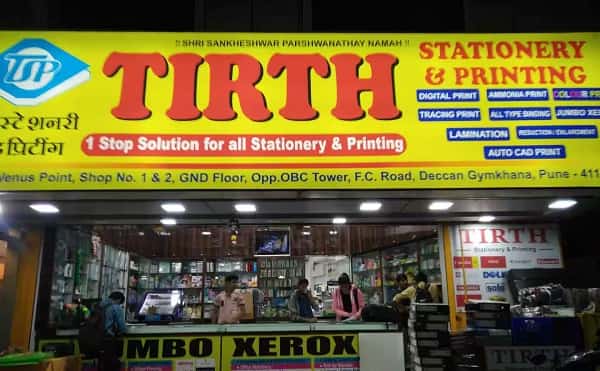
2. Stationery, Printing, and Documentation Services
Estimated startup cost: Rs. 2 lakh – Rs. 5 lakh Monthly earning potential: Rs. 35,000 – Rs. 1 lakh
Industrial areas generate an enormous volume of paperwork that most people outside the sector never think about. Purchase orders, delivery challans, gate passes, work contracts, quality certificates, GST invoices, labour compliance documents, Provident Fund records, factory inspection forms, and safety training certificates — every factory generates hundreds of these documents daily, and the staff responsible for producing and managing them need external printing and documentation support that the factory itself does not provide in-house.
A printing and documentation centre near an industrial cluster serves multiple distinct customer categories simultaneously. Factory accounts departments need bulk invoice printing and binding. HR departments need notice boards, policy documents, and appointment letters. Small contractors need their agreements typed and printed. Workers need document photocopies for PF applications, bank account openings, and ESI registrations. The combined daily volume of these needs, across twenty to thirty factories in a cluster, sustains a well-equipped printing centre with consistent daily traffic.
Adding notary-adjacent documentation services — typing and printing affidavits, help with government form submission, labour court document preparation — extends the revenue base into an area where the demand is real, the expertise barrier is low, and the pricing can be somewhat higher given the relative complexity of the service.
3. Vehicle Repair and Two-Wheeler Service Centre
Estimated startup cost: Rs. 3 lakh – Rs. 8 lakh Monthly earning potential: Rs. 50,000 – Rs. 1.5 lakh
Industrial areas are home to three distinct vehicle populations that generate consistent repair and maintenance demand. The first is the personal two-wheelers of factory workers — thousands of motorcycles and scooters that bring workers from surrounding residential areas every day and need regular servicing, tyre replacement, and minor repairs. The second is the fleet of factory vehicles — loading vehicles, forklifts, company cars and vans — that need on-call emergency repair services when they break down. The third is the commercial trucks and logistics vehicles that service the industrial cluster — these large-vehicle drivers need tyre repair, basic mechanical service, and battery replacement from a workshop they can access quickly without losing a full day’s delivery schedule.
A vehicle repair centre that handles all three categories — two-wheeler service and repairs as its primary daily volume driver, with commercial vehicle emergency repair as a secondary higher-ticket service — serves the industrial area’s complete vehicle population from a single location. The two-wheeler servicing volume from factory workers provides the daily revenue baseline, while commercial vehicle work provides the high-ticket episodic income that significantly improves monthly earnings without proportionally increasing operating costs.
4. Packaged Drinking Water Supply
Estimated startup cost: Rs. 8 lakh – Rs. 20 lakh Monthly earning potential: Rs. 60,000 – Rs. 2 lakh
Every factory in India is legally required to provide clean drinking water to its workers under the Factories Act. Many factories rely on external supply rather than maintaining their own treatment facility — particularly smaller MSME units in industrial clusters where the capital cost of in-house water treatment is hard to justify. A packaged drinking water supply business serving an industrial cluster provides 20-litre jar water on a scheduled daily basis to factories, office buildings, and construction sites within the cluster.
The industrial water supply model has a specific advantage over the residential model described in other articles: order volumes per customer are much larger. A factory of 300 workers may consume 30 to 50 twenty-litre jars per day. At Rs. 30 to Rs. 50 per jar, one factory of this size generates Rs. 900 to Rs. 2,500 in daily revenue. Securing contracts with five to eight such factories in a cluster builds monthly revenue that far exceeds what the same capital investment would generate serving residential customers.
The business requires BIS certification, an FSSAI licence, and a reliable RO-UV purification system — all of which involve lead time before commercial launch. Beginning the certification process well in advance of the planned launch date is essential.
5. Manpower and Labour Contractor Services
Estimated startup cost: Rs. 1 lakh – Rs. 3 lakh Monthly earning potential: Rs. 60,000 – Rs. 2 lakh
Every industrial area in India has a consistent and persistent demand for semi-skilled and unskilled workers — for loading and unloading, housekeeping, security, packing, and basic assembly work that factories need to fill on a daily or monthly basis. A registered manpower contractor who maintains a database of available workers, ensures their documentation (PF, ESI, Aadhaar linkage) is in order, and provides reliable daily attendance for contracted factories fills a need that the factories themselves do not want to manage directly.
The business model is based on a per-worker margin — you charge the factory a daily or monthly rate per worker and pay the workers a slightly lower rate, keeping the difference as your margin. With proper registration (Shop and Establishment Act, ESI and PF registration as an employer), this margin — typically Rs. 30 to Rs. 80 per worker per day — compounded across 50 to 100 workers provided to multiple factories generates consistent, predictable income.
The key to this business is both database depth (having enough verified workers available to meet sudden demand increases) and reliability (ensuring workers show up on the days they are committed). Factories that find a reliable manpower contractor become long-term clients because switching contractors is logistically disruptive.
Frequently Asked Questions
Q1. Do industrial area businesses need any special permissions from the industrial authority
A: Businesses operating on private commercial plots near industrial zones need standard municipal trade licences. Businesses operating within the industrial estate premises may need permission from the Industrial Development Corporation managing the estate. Food businesses need FSSAI registration regardless of location.
Q2. Which industrial-area business gives the most stable monthly income?
A: Factory canteen contracts and packaged water supply provide the most contractually stable monthly income since they operate on fixed-term agreements with guaranteed minimum volumes. Manpower contracting also generates highly predictable income once factory relationships are established.
Q3. Is proximity to the industrial gate entrance important for these businesses?
A: Critical for food and documentation services — workers typically have 30 to 45 minutes for breaks and will not travel far. Vehicle service and water supply can operate from slightly further away since their service is delivered to the customer rather than requiring the customer to visit.
Q4. What is the best way to get a factory canteen contract?
A: Visit the HR or administration departments of factories in the industrial area directly. Carry your FSSAI registration, sample menu, and pricing structure. Factories typically review canteen arrangements at the start of each financial year — approaching in February and March gives you the best timing.
Q5. Are these businesses viable near smaller industrial clusters?
A: Yes — smaller clusters in Tier-2 cities often have less organised commercial infrastructure around them than metro industrial zones, making first-mover advantage stronger. The absolute revenue is lower but so is competition, and the relationship-based selling that characterises all industrial-area businesses works even better in smaller settings.