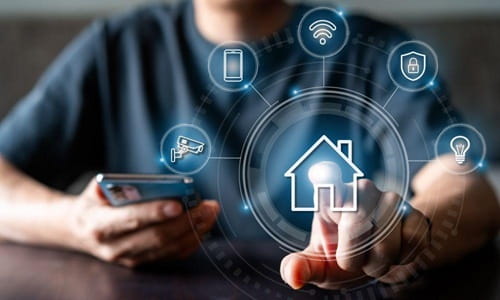
Picture walking into your home and having the lights adjust automatically, the AC switch on before you even step through the door, and your front gate unlock with a simple app tap. Home automation used to feel like something out of a sci-fi movie reserved for wealthy tech enthusiasts, but today, Indian homeowners across cities are quietly transforming ordinary flats and houses into smart homes, one device at a time. The catch, of course, is that a proper smart home setup, video doorbells, smart locks, automated lighting, voice-controlled hubs, and security cameras, can easily add up to ₹50,000-₹2 lakh or more depending on how far you want to go.
That upfront cost is exactly what stops many interested homeowners from taking the plunge. Here’s the good news most people don’t realise: you don’t need to save up for months or dip into your emergency fund to build a smart home. Consumer durable loans, a genuinely underused financing option in India, are specifically designed to spread out exactly this kind of purchase into manageable EMIs, often at surprisingly low or even zero extra cost.
Understanding What a Consumer Durable Loan Actually Covers
A consumer durable loan is essentially a specialised personal loan built around financing electronics, appliances, and gadgets rather than being used for open-ended personal expenses. While most people associate these loans with refrigerators, washing machines, and televisions, the category genuinely extends to smart home devices too, smart locks, home automation hubs, security camera systems, smart lighting kits, and voice assistants all typically qualify under the same umbrella.
Unlike a standard personal loan where funds land in your bank account for you to use however you like, consumer durable loans are usually tied directly to a specific purchase at a partner store or retailer, with the loan amount going straight toward that transaction. This structure is exactly what allows lenders to offer such attractive terms, since the loan is secured against a clearly defined, traceable purchase rather than open-ended spending.
Why “No Cost EMI” Makes Smart Home Purchases Genuinely Affordable
This is probably the single most attractive feature of consumer durable loans, and it’s worth understanding properly before you assume you’re paying hefty interest on your smart home setup. Under a No Cost EMI arrangement, you repay exactly the loan amount you borrowed, split into equal monthly instalments, with no additional interest charged on top.
How does this work financially for the lender and retailer? Typically, the interest cost gets absorbed either by the retailer as a promotional incentive or adjusted through a discount that’s effectively built into the product’s pricing structure. This means a ₹1 lakh smart home automation package could genuinely convert into twelve equal instalments of roughly ₹8,333 each, with no interest markup at all, provided you qualify for a No Cost EMI scheme specifically.
Not every purchase or lender offers this though, and some come with a “Low-Cost EMI” alternative instead, where a modest interest charge does apply. It’s worth explicitly checking which structure you’re being offered before assuming zero-interest financing applies automatically.
How Much You Can Actually Borrow
Consumer durable loan amounts in India typically range anywhere from ₹5,000 on the lower end to as much as ₹15 lakh at certain banks for larger lifestyle purchases, though most smart home setups comfortably fall well within this range. HDFC Bank, for instance, offers up to ₹15 lakh with 100% financing on eligible consumer durable purchases, while several NBFCs and fintech-driven lenders cap amounts closer to ₹5-8 lakh depending on their specific product.
For a typical smart home automation project, smart locks, a security camera system, automated lighting for a few rooms, and a central hub, your total spend might realistically land somewhere between ₹40,000 and ₹1.5 lakh, comfortably within what nearly every lender in this space is willing to finance.
Where You Can Actually Apply
Almost every major bank and several dedicated NBFCs run active consumer durable loan programs, and increasingly, these are integrated directly at the point of purchase rather than requiring a separate application process beforehand.
HDFC Bank, Bajaj Finance, IDFC First Bank, and HDB Financial Services all run well-established consumer durable financing schemes, often available directly at large electronics retailers or smart home specialty stores where you’re making your purchase. Many of these processes are now entirely digital, involving little more than an OTP verification and basic KYC upload at the point of sale, with approval and disbursal happening within minutes rather than days.
If your smart home purchase is happening through an online retailer rather than a physical store, several platforms now integrate EMI conversion options directly at checkout, letting you select a consumer durable financing plan from a partner bank without needing to separately visit a branch.
What You’ll Need to Qualify
Eligibility for these loans tends to be considerably more relaxed than what you’d encounter applying for a larger personal or home loan, largely because the amounts involved are smaller and the purchase itself is clearly defined.
Most lenders look for a minimum monthly income around ₹15,000, along with at least a year of stable employment if you’re salaried. Self-employed applicants can generally qualify too, provided they can show reasonably consistent income through bank statements or basic financial documents. Your credit score still matters, a stronger score improves your approval odds and can unlock better EMI terms, but the bar here is genuinely lower than what secured, larger-ticket loans typically demand.
Documents You’ll Actually Need
The documentation requirement for consumer durable loans is refreshingly light compared to most other credit products. You’ll typically need standard identity proof, Aadhaar, PAN, or a driving licence, along with basic address proof, and for larger purchases, a recent bank statement showing your income pattern.
Since much of this process has moved to digital verification through Aadhaar-linked KYC, many in-store or online applications now require nothing more than your mobile number, an OTP, and a quick upload of your PAN and Aadhaar details, with the entire approval happening in real time at the checkout counter.
Comparing Consumer Durable Loans to Credit Card EMI Conversion
If you already own a credit card with sufficient limit, it’s worth pausing to compare this option against a dedicated consumer durable loan before committing to either. Credit card EMI conversion can sometimes offer comparable no-cost or low-cost terms, particularly during festive sales periods, without requiring a fresh loan application altogether.
That said, consumer durable loans often extend to larger amounts than your available credit card limit might allow, and they don’t tie up your card’s credit limit for other expenses during the repayment period. If your smart home project is a larger, one-time investment, a dedicated consumer durable loan generally makes more sense than stretching your credit card across a big purchase.
Watching Out for the Fine Print
Even with attractive No Cost EMI branding, it’s worth checking a few details before signing anything. Processing fees, though often nominal, can still apply and typically range from 0% to a small percentage of the loan amount. Foreclosure or prepayment charges are also worth confirming upfront, particularly if you anticipate wanting to close the loan early once you have surplus funds, since these can sometimes run a few percentage points of the outstanding balance.
Late payment penalties, generally a fixed charge around a few hundred rupees per missed EMI, apply if you slip on a payment date, and repeated late payments can genuinely dent your credit score over time. Reading through these specific terms before finalising your purchase ensures there are no surprises buried beneath the attractive zero-interest headline.
Frequently Asked Questions
Q1. Can I get a consumer durable loan for a smart home setup bought entirely online, not from a physical store?
Yes, many online retailers and marketplaces now offer EMI conversion options directly at checkout through partner banks and NBFCs, letting you select a consumer durable financing plan without visiting a physical branch, provided the specific lender has a tie-up with that particular online platform.
Q2. Does a lower credit score completely rule out getting a consumer durable loan?
Not necessarily, though it can affect your approval odds and whether you qualify for the best No Cost EMI schemes specifically. Some NBFCs are more flexible with weaker credit profiles compared to banks, though you might end up with a Low-Cost EMI option involving some interest rather than a fully interest-free plan.
Q3. Is there a minimum purchase amount required to use a consumer durable loan for smart home devices?
Yes, most lenders set a minimum threshold, often around ₹5,000, below which financing isn’t typically offered, since smaller purchases don’t usually justify the administrative cost of setting up a formal loan structure.
Q4. What happens if I want to return or exchange a smart home device I financed through this loan?
This depends entirely on the retailer’s own return policy rather than the loan itself, since the loan amount has already been disbursed to the seller. If a return is approved, you’d typically need to coordinate with both the retailer and your lender to have the loan cancelled or adjusted accordingly, so it’s worth clarifying this process with the seller before finalising your purchase.