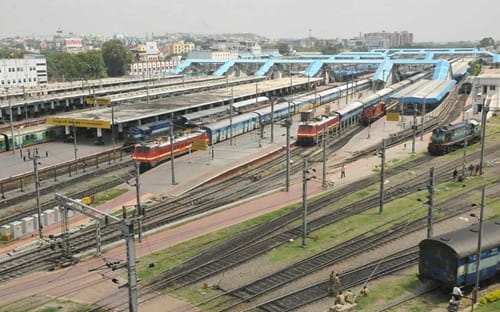
Railway stations are among the most consistently high-footfall locations in India — not just in the major junctions, but across every town, district capital, and semi-urban node where Indian Railways operates. Every single day, over 23 million passengers travel on Indian Railways, passing through thousands of stations ranging from the behemoths of CSMT Mumbai, Howrah, and New Delhi to the mid-size A-category stations in cities like Patna, Lucknow, and Coimbatore. Every one of these travellers carries a need: food, water, something to read, a phone charger, a last-minute essential forgotten at home. The commercial opportunity in railway station surroundings is not seasonal and not discretionary — it is a function of pure, daily footfall multiplied by the universal travelling human need for convenience.
India’s railway station upgrade programme under the Amrit Bharat Station Scheme is making this opportunity even more compelling in 2026. Over 1,300 stations are being upgraded with new facilities, improved access roads, better lighting, and commercial zones designed to attract private enterprise. New station footfall zones and organised commercial frontage near upgraded stations are creating fresh entry points for entrepreneurs who might not have found viable shop space near older, congested station areas.
1. Fast Food and Snack Stall
Estimated startup cost: Rs. 1.5 lakh – Rs. 4 lakh Monthly earning potential: Rs. 40,000 – Rs. 1.2 lakh
No business near a railway station is more natural than food. Passengers waiting for delayed trains, families eating before departure, porters taking a break, railway staff on a shift change, auto and taxi drivers parked outside — all of them eat, and all of them prefer eating something hot, affordable, and quickly available from somewhere close to where they are already standing.
A well-run fast food stall near a railway station entrance operates in a customer acquisition environment unlike almost any other location in India. You do not need marketing. You do not need Instagram posts. You need a hot tawa, a clean counter, and consistent food that justifies coming back at the next journey. Poha and chai in the morning, chaat and dosa in the afternoon, bread pakoda and samosa as the evening trains fill up — the menu adapts to peak times naturally.
The most important operational variable is location relative to the main exit. A stall 50 metres from the main station exit in the direct pedestrian path will generate three to four times the revenue of an equivalent stall 200 metres away on a quieter side road. Paying a slight premium for the right spot is almost always the correct commercial decision near a railway station.
2. Luggage Storage and Cloakroom Service
Estimated startup cost: Rs. 1 lakh – Rs. 3 lakh Monthly earning potential: Rs. 30,000 – Rs. 80,000
This is one of the most underrated and most consistently profitable small businesses available near railway stations in India in 2026 — and it requires almost no inventory, no perishable inputs, and virtually zero marketing once established. Travellers who arrive early, who have connection gaps of two to six hours, who want to explore the city before their evening train, or who simply do not want to carry heavy luggage to a meeting or appointment near the station will pay Rs. 30 to Rs. 100 per bag per day for reliable, secure, accessible storage.
Indian Railways does provide cloakroom services inside some stations, but the operating hours are limited, the queues can be long, and many mid-size stations do not have functional cloakroom facilities at all. A private luggage storage business just outside the station entrance — secured, staffed, with a simple receipt system — fills this gap completely.
The business scales easily with demand: add lockers for smaller items as volumes increase, extend operating hours to 24 hours for stations with late-night traffic, and build relationships with nearby hotels who have early check-in problems and need a reliable storage solution for guests arriving before rooms are ready.
3. Mobile Phone Charging and Accessory Shop
Estimated startup cost: Rs. 1 lakh – Rs. 2.5 lakh Monthly earning potential: Rs. 25,000 – Rs. 70,000
In 2026, a dead phone battery at a railway station is not just an inconvenience — it is a genuine problem. Train tickets are on apps, PNR status is checked on phones, family arrival alerts come on WhatsApp, and food ordering at the next station is done through apps. A traveller whose phone battery dies two hours into a journey is a genuinely distressed customer who will pay a premium for a solution.
A mobile charging kiosk near a railway station — offering both coin-operated or pay-per-hour secure charging lockers and basic phone accessory retail (cables, earphones, power banks, screen protectors, fast chargers) — captures this distress demand daily. The charging locker model, where a traveller locks their phone in a secured slot with a cable while they wait, has proven successful near airports internationally and is underdeployed near Indian railway stations where the same need exists at higher volumes.
The accessory retail component alongside the charging service creates a secondary revenue stream. A traveller who forgot their earphones at home, whose charging cable just broke, or who wants a local SIM card for a journey buys on impulse without any price comparison — the need is immediate and the location is convenient.
4. Travel and Tourism Services Kiosk
Estimated startup cost: Rs. 2 lakh – Rs. 5 lakh Monthly earning potential: Rs. 40,000 – Rs. 1.2 lakh
Railway stations are, by definition, the physical manifestation of people in transit. Every person in a railway station is either going somewhere or returning from somewhere, and a meaningful proportion of them have upcoming travel arrangements that require additional services: taxi booking to their final destination, hotel accommodation at the destination city, tour packages for pilgrimage or leisure travel, local sightseeing arrangements, or bus ticketing for onward connectivity.
A travel services kiosk near a station entrance that offers these services — through partnerships with local taxi operators, hotel booking portals like MakeMyTrip or Yatra, tour operators for popular pilgrimage routes, and bus ticketing aggregators — earns commission on every booking made. The customer is already in travel mode and already predisposed to making travel decisions. A well-positioned, properly branded kiosk with clear rate displays and a friendly staff member captures this intent efficiently.
This model works particularly well near stations that are gateway cities for pilgrimage destinations — Varanasi, Tirupati, Puri, Shirdi, Haridwar — where a large proportion of arriving passengers are specifically looking for hotel and local transport assistance immediately upon arrival.
5. Laundry and Quick Garment Repair Service
Estimated startup cost: Rs. 2 lakh – Rs. 5 lakh Monthly earning potential: Rs. 35,000 – Rs. 90,000
This idea targets a specific and consistently underserved customer segment near major railway stations: daily commuters, migrant workers, railway staff, and long-stay passengers who live near the station rather than pass through it. A professional laundry service — wash, dry, fold, iron, and ready for pickup — serving the dense residential population that typically clusters near major railway stations provides steady, subscription-based daily income.
The garment repair component (replacing buttons, fixing torn pockets, quick hemming) adds a convenience service that railway station-area residents genuinely value, particularly working-class residents who wear their clothes regularly and cannot afford tailoring delays. Quick turnaround — same day or next day — is the competitive differentiator in this market, and achieving it consistently is what builds the loyal, repeat customer base that makes this business financially stable rather than unpredictable.
Frequently Asked Questions
Q1. Do I need Indian Railways’ permission to set up a business near a railway station
Businesses operating on private commercial land adjacent to the station do not require IRCTC or Indian Railways permission. Businesses operating within the station premises — on platforms or in waiting rooms — do require IRCTC tendering or licensing. Most small commercial setups are located on adjacent private or municipal land and operate under standard municipal trade licences.
Q2. Which railway station business earns the fastest returns?
Food stalls and mobile charging kiosks generate revenue from the first day of operation and typically recover initial investment within three to four months in a well-positioned location.
Q3. How important is the specific location relative to the station entrance?
Critically important. Even a 100-metre difference in proximity to the main pedestrian exit significantly affects footfall. Always observe pedestrian patterns for two to three days before committing to a specific spot.
Q4. Is the railway station area competitive?
Food is the most competitive category near most stations. Luggage storage, phone charging services, and laundry are significantly less competitive despite comparable demand. These service categories offer better differentiation opportunity for new entrants.
Q5. Can these businesses work near smaller Tier-2 city stations?
Yes — several of these businesses (food, luggage storage, travel services) work proportionally well near smaller city stations where the formal commercial infrastructure is less developed and competition is thinner, even though absolute footfall is lower.