Schools and colleges are demand factories. Every morning, thousands of students converge on a single location, each carrying specific needs — notebooks, pens, food, project materials, printed documents — that they satisfy in the commercial ecosystem surrounding their institution. Unlike a mall or a marketplace where consumers arrive with varying intentions, the students who pass your shop do so with predictable, repeating, daily needs that do not vary significantly across the academic year.
The commercial opportunity near educational institutions in India in 2026 is stronger than it has been in a long time, for reasons that go beyond simple footfall. India’s Gross Enrolment Ratio in higher education reached 28.4 percent in the 2024-25 academic year, the highest ever recorded, meaning more students are attending college than at any previous point. Private school enrolments have grown simultaneously, particularly in Tier-2 and Tier-3 cities where the aspirational middle class is actively investing in better-quality education for children. Both trends translate into more feet outside your shop, more regularly, for more months of the year.
1. Stationery and Photocopy Centre
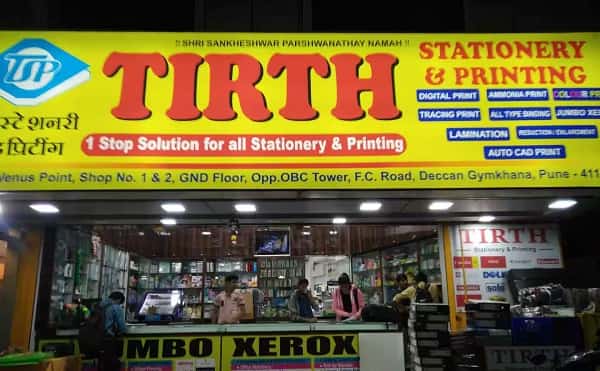
Estimated startup cost: Rs. 2 lakh – Rs. 5 lakh Monthly earning potential: Rs. 40,000 – Rs. 1.2 lakh
A well-stocked stationery shop with an attached photocopy and print centre is the most universally consistent business across every school and college neighbourhood in India, from Kanyakumari to Srinagar. Students need it every single day. Assignment photocopies, printed notes, graph paper, drawing sheets, pens, pencils, project files, spiral binding, lamination — the demand is as reliable as the academic calendar and partially immune to digital disruption because the Indian examination system continues to be paper-based.
The photocopy machine itself is the revenue engine. A single commercial-grade photocopier handles Rs. 1,500 to Rs. 4,000 of revenue daily near a busy college, and the cost per copy at the consumer level is Rs. 0.50 to Rs. 1 — nearly pure margin after paper and toner costs. Adding a colour printing station for project covers, a lamination machine, and a spiral binding service turns the same floor space into a full document service centre with multiple revenue streams.
The stationery component captures additional daily spend. Brands like Classmate, Reynolds, Natraj, and Camlin move in genuinely high volumes near schools. Seasonal spikes at the start of the academic year — when parents buy in bulk for their children — and during examination periods create revenue peaks that a well-prepared owner uses to build working capital buffer for quieter periods.
2. Food Stall or Small Canteen
Estimated startup cost: Rs. 1 lakh – Rs. 3 lakh Monthly earning potential: Rs. 30,000 – Rs. 1 lakh
Hungry students are the most reliable customer base in India. The food requirement around schools and colleges operates across three daily peaks: the morning break, the lunch period, and the post-school or post-college snack rush when students leave. Each peak creates concentrated demand that a well-positioned food stall or small canteen captures with minimal marketing because the customers come to the food out of routine, not discovery.
The menu that works best near schools differs from college canteen fare. Near schools, parents’ sensibility matters — parents in the morning pickup queue judge the cleanliness and food safety of every stall near their child’s institution. Samosas, sandwiches, vada pav, rolls, and fresh juice served in clean, food-safe packaging from a visibly hygienic stall captures the highest volumes. Near colleges, the appetite for variety is higher — Maggi variations, chaat, Chinese-style fast food, and café-style sandwiches and milkshakes serve the older demographic effectively.
In 2026, adding a QR code menu and UPI payment acceptance has become nearly mandatory near urban colleges where the student demographic pays digitally as a first reflex rather than a last resort. The operational capital required is genuinely low — a decent gas stove, a food cart or small prep counter, a month of ingredient working capital, and FSSAI basic registration is your entire startup requirement.
3. Coaching and Tuition Centre
Estimated startup cost: Rs. 3 lakh – Rs. 8 lakh Monthly earning potential: Rs. 50,000 – Rs. 2 lakh
No investment in a school neighbourhood generates more long-term relationship equity than a coaching centre that consistently produces results. Parents in India in 2026 are spending a higher proportion of household income on supplemental education than at any previous point — JEE, NEET, CUET, SSC, UPSC, and board exam coaching are no longer considered extras but essential investments in a child’s competitive positioning.
A coaching centre near a school or college has a structural advantage that a coaching centre in any other location lacks: it sits directly in the path of its target customers. Students who finish school at 2 PM and have a coaching class beginning at 3 PM need only walk across the road. The convenience is not trivial — parents who choose between two comparable coaching centres will reliably choose the one that is closer to the school, even at a slight price premium, because it reduces the logistics burden on the family.
The 2026 model for a successful neighbourhood coaching centre is hybrid — physical classroom sessions supplemented by a WhatsApp group for doubt resolution and recorded session access for students who miss classes. This model does not require expensive learning management software. A consistent WhatsApp broadcast list, a Google Drive folder of recorded sessions, and a Telegram channel for study materials is sufficient and builds retention that purely offline competitors cannot match.
4. Uniforms, Books, and School Supplies Store
Estimated startup cost: Rs. 3 lakh – Rs. 7 lakh Monthly earning potential: Rs. 50,000 – Rs. 1.5 lakh
Near schools in particular, a dedicated uniform and textbook store occupies a commercial position of genuine strategic value. School uniforms are institution-specific — parents cannot buy them online from a generic retailer because each school’s specific combination of fabric, colour, stitching detail, and logo is only available through authorised vendors. If your store has the authorised vendor relationship with one or more schools in your area, you own a captive market for the duration of that relationship.
The textbook component of this model adds a revenue layer that is most concentrated at the academic year’s start — typically June and July for most Indian school boards — but extends through the year as students need supplements, reference books, guides, and competitive exam preparation materials. NCERT books, state board textbooks, and reference materials from publishers like S Chand, Arihant, and MTG move in large volumes near schools where the student density is high.
Building the uniform vendor relationship is the strategic investment that requires the most work upfront but delivers the most durable commercial returns. Schools typically have purchase committee meetings in January and February where vendors present for the following academic year. Attend these, present professionally, and demonstrate fabric and stitching quality. Once established as the approved vendor for two or three schools, the business operates as a near-monopoly during peak uniform season.
5. Digital Services Centre (Printing, Scanning, Documentation)
Estimated startup cost: Rs. 2 lakh – Rs. 5 lakh Monthly earning potential: Rs. 35,000 – Rs. 1 lakh
Beyond photocopy and basic printing, college students in 2026 have a broader and more consistent set of digital service needs: colour printing for project presentations, scanning and PDF conversion of handwritten notes, large-format poster printing for events, resume printing for campus placement season, ID card lamination, and occasionally, basic graphic design for college fest branding. A digital services centre near a college that covers all of these needs comprehensively becomes a one-stop document hub that the entire campus routes through routinely.
The additional layer that is gaining traction near engineering and management colleges specifically is basic digital literacy support — helping students with PDF editing, Canva designs, and document formatting for submission deadlines. Charging a small service fee (Rs. 50 to Rs. 200 per task) for these assists adds incremental revenue without additional equipment.
Frequently Asked Questions
Q: Which business near schools generates the most consistent year-round income?
A: Stationery and photocopy centres generate the most consistent income throughout the academic year, with peaks during examination and project submission periods. Food stalls have equally consistent demand but require more operational attention.
Q: When is the best time to open a school-adjacent business?
A: March to May is the ideal period to set up and soft-launch a school-adjacent business, allowing you to build visibility before the June-July academic year start when purchasing volumes are highest.
Q: Do I need special permission to operate near schools?
A: Food stalls near schools require FSSAI registration. Local municipal shop licences and GST registration apply depending on turnover. No education-specific permission is required for commercial establishments operating adjacent to school premises from a public road.
Q: How do I get the authorised uniform vendor status for a school?
A: Contact the school’s purchase committee or administrative office between December and February, present fabric and stitching samples, provide competitive pricing, and offer volume commitment guarantees. Schools prefer vendors who can demonstrate financial stability and supply reliability.
Q: Can a coaching centre near a school compete with large coaching chains like FIITJEE or Allen?
A: Yes — neighbourhood coaching centres compete on proximity, personalisation, fee affordability, and access to the teacher. Large chains compete on brand reputation and preparation material depth. The businesses serve partially overlapping but meaningfully distinct customer segments.