India’s aviation sector in 2026 is operating at a scale that would have seemed ambitious even five years ago. Domestic air passengers exceeded 152 million in the financial year 2024-25, and the trajectory continues upward. New airports have opened — Navi Mumbai, Jewar (Noida International), Hosur — while existing airports in Bengaluru, Hyderabad, Chennai, Kolkata, and Ahmedabad have undergone significant capacity expansions. The Ude Desh Ka Aam Naagrik (UDAN) regional connectivity scheme has added dozens of smaller cities to the air network, creating commercial zones around airports that simply did not exist before.
The customer profile near an airport is meaningfully different from the railway station customer — generally higher income, more time-conscious, more brand-aware, and more comfortable spending for convenience. A business near an airport is not competing for the mass-market, price-sensitive traveller who carefully compares prices. It is serving someone whose time costs more than their money, whose taxi booking might cost Rs. 800 when a bus would cost Rs. 80, and who considers that trade entirely reasonable. This income and convenience sensitivity shapes which businesses work near airports and why they work there better than anywhere else.
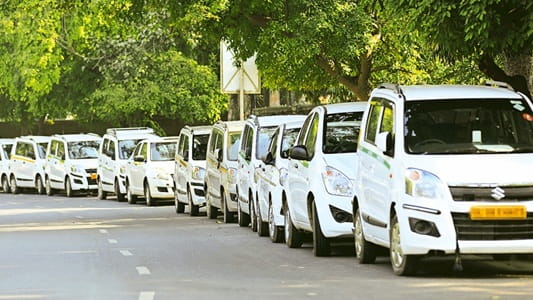
1. Cab and Taxi Aggregation or Rental Service
Estimated startup cost: Rs. 5 lakh – Rs. 15 lakh Monthly earning potential: Rs. 60,000 – Rs. 2 lakh
Every arriving passenger at an Indian airport needs ground transportation. Ola and Uber provide this for a large proportion, but gaps exist — corporate travellers who want a guaranteed vehicle with a named driver rather than a pool car, outstation passengers who need a vehicle for the full day or for multiple days, families with excessive luggage who need a larger vehicle than a typical cab, and travellers arriving on late-night or early-morning flights when app-based cab availability is lowest.
A reliable, branded ground transportation service operating near an airport — whether directly or as a vehicle fleet supplied to a corporate travel desk — fills these gaps. The model works best as a fleet of three to five well-maintained vehicles (SUVs for family travel, sedans for executive travel) operated on a pre-booking basis with transparent fixed rates to the city’s key destinations. A professional website, tie-ups with nearby hotels to recommend your service for airport transfers, and a well-maintained Google My Business listing generates bookings consistently.
The competitive advantage in this market is reliability — a service that consistently sends the vehicle ten minutes before the scheduled time, with a driver who knows the route and has a clean car, builds corporate account relationships that generate monthly guaranteed volume beyond individual bookings.
2. Hotel or Budget Accommodation
Estimated startup cost: Rs. 15 lakh – Rs. 20 lakh+ Monthly earning potential: Rs. 1 lakh – Rs. 4 lakh
Airport-adjacent accommodation serves three distinct and high-value customer segments in 2026. The first is the early-morning or late-night flight customer who finds it genuinely more convenient to stay near the airport the night before or after a flight rather than travelling from the city centre at 3 AM. The second is the transit passenger with a lengthy connection who needs a few hours of rest rather than sitting in the terminal. The third is the airport worker — airline staff, ground handling personnel, cargo handlers — who need affordable, clean accommodation within walking distance of their workplace.
Budget and mid-scale accommodation near airports — clean rooms, WiFi, simple breakfast, easy check-in and check-out — commands premium pricing relative to equivalent accommodation elsewhere in the city because of the location value. A well-rated OYO-partnered or independent budget hotel near a Tier-2 airport town can charge Rs. 800 to Rs. 1,800 per night and maintain high occupancy throughout the year. Listing on OYO, Treebo, Zostel, and Google Hotels provides immediate visibility to the travelling customer base without requiring independent marketing expenditure.
3. Retail and Convenience Store
Estimated startup cost: Rs. 3 lakh – Rs. 8 lakh Monthly earning potential: Rs. 50,000 – Rs. 1.5 lakh
The area outside an airport is full of people in a specific state of mind: time-pressured and convenience-driven. A traveller dropping off a passenger, waiting for an arrival, or completing a quick airport trip will buy almost anything from a conveniently located store without significant price comparison — a bottle of water, a phone charger they forgot, a snack, a SIM card, a travel adapter, basic toiletries, or a magazine. The impulse purchase frequency near airports is significantly higher than in most retail locations because the customer’s mental bandwidth is occupied with travel logistics rather than shopping optimisation.
A well-stocked convenience store near the airport’s main exit — combining FMCG staples, travel accessories, electronics accessories, packaged snacks, cold beverages, and SIM cards from major telecom operators — serves this impulse need effectively. The SIM card sales component is particularly profitable near international airports where arriving foreign passengers need local connectivity immediately and are willing to pay a service fee for assistance in selecting and activating the right plan.
4. Café or Quick Service Restaurant
Estimated startup cost: Rs. 5 lakh – Rs. 15 lakh Monthly earning potential: Rs. 70,000 – Rs. 2.5 lakh
Airport-adjacent cafés and QSR outlets serve a specific and profitable role that neither the airport’s internal food offerings nor the city-centre restaurant can fully cover. Passengers who arrive at the departure city hours early — to avoid traffic, to be safe — often kill time in the surrounding commercial area rather than in the airport itself where prices are airport-premium. Families seeing off travellers want somewhere to sit together for tea or coffee before the farewell. Ground crew and airline staff prefer the pricing and relaxed environment of an external café over the terminal’s commercial food zone.
A café near an airport that gets this right — comfortable seating, reliable WiFi, good coffee, fast service, and a menu that works for both quick bites and longer sit-downs — builds a regular customer base from the airport’s permanent employee population alongside the transient traveller segment. The employee base is particularly valuable because it is large, consistent, and daily — ground handlers, airline staff, cargo workers, customs and immigration personnel, and CISF officers collectively form a captive customer base that no marketing campaign can replicate.
5. Packing and Courier Services
Estimated startup cost: Rs. 2 lakh – Rs. 5 lakh Monthly earning potential: Rs. 40,000 – Rs. 1.2 lakh
Passengers who arrive at an airport and discover their luggage is overweight — or who want to send a package back from a journey without carrying it — face a problem that a packaging and courier service near the airport solves immediately. Airline excess baggage charges are steep: Rs. 500 to Rs. 1,000 per kilogram depending on the airline and route. A passenger who can courier the excess luggage home for Rs. 300 to Rs. 500 total makes an easy financial decision.
A packing and courier service near an airport provides professional luggage wrapping (which also provides damage protection — a separate customer need), excess baggage courier services through Delhivery, DTCP, or Blue Dart partnerships, and small parcel shipping for travellers who want to send local handicrafts or gifts without the airline weight penalty. The service model involves transparent pricing, reliable partner courier agencies, and quick service — because the customer typically has a flight to catch.
Frequently Asked Questions
Q1. Do airport-adjacent businesses need special permissions?
Businesses operating on private commercial land near airports operate under standard municipal trade licences and do not require Airports Authority of India permission. Any business operating within the airport boundary or controlled zone requires AAI tendering. Ground transport operations may additionally require state transport department permits.
Q2. Which airport-adjacent business requires the least investment?
Packing and courier services (Rs. 2 to Rs. 3 lakh) and convenience stores (Rs. 3 to Rs. 5 lakh) are the most accessible investment entry points from this list.
Q3. Is an airport-adjacent business viable near Tier-2 city airports?
Yes — UDAN scheme airports in Tier-2 cities like Hubli, Tirupati, Kishangarh, and Darbhanga have created new commercial zones with virtually no established competition. First-mover advantage in these locations is substantial.
Q4. How important are online listings for airport-adjacent businesses?
Critical. Travellers frequently search “near airport hotel” or “restaurant near airport” on Google Maps before or after a flight. A well-rated Google My Business listing with photos, accurate hours, and a phone number generates a disproportionately high volume of walk-in customers relative to the effort required.
Q5. Which airport business serves the most repeat customers?
Café and QSR outlets serving airport employees generate the highest frequency of repeat visits. Ground staff, airline employees, and security personnel represent a daily captive customer base that provides income stability independent of flight schedules and seasonal travel patterns.