India’s temple economy is one of the most extraordinary and most consistently underestimated commercial ecosystems in the world. According to the National Sample Survey Office, Hindus in India spend approximately Rs. 4.74 lakh crore annually on religious pilgrimages — a figure that makes India’s religious economy larger than many entire national economies in Asia. The Tirumala Tirupati Devasthanams receives between 50,000 and 1,00,000 pilgrims every single day. The Ram Temple at Ayodhya received over 11 crore visitors within the first six months of its consecration in January 2024. The Kashi Vishwanath Corridor redevelopment in Varanasi drew a dramatic increase in footfall from the very day it opened. And these are just the headline destinations.
India has approximately 10 lakh temples, and while only a fraction have the footfall of the major pilgrimage destinations, even a modest neighbourhood temple in a Tier-2 city or a rural district provides a consistent, loyal daily customer base for businesses that serve the spiritual needs of its devotees. A temple-adjacent business in India does not require marketing research or demand generation — the devotees are already coming. The only question is whether the business serves them with enough quality and reliability to become part of their ritual.
1. Puja Items and Flower Shop
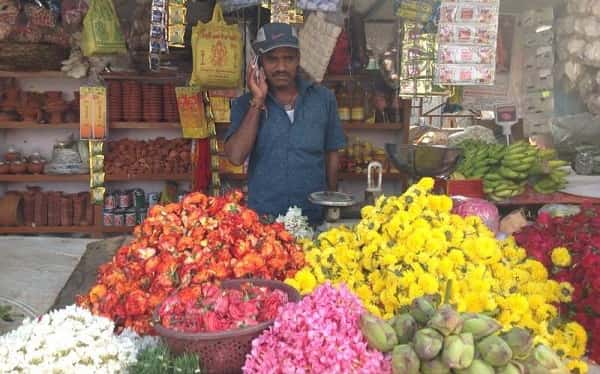
Estimated startup cost: Rs. 1 lakh – Rs. 3 lakh Monthly earning potential: Rs. 30,000 – Rs. 1 lakh
The flower and puja items shop is the most universal and most consistently profitable business near any temple in India. The devotee who visits a temple needs specific items for their offering — flowers (marigold garlands, rose petals, lotus, jasmine), coconut, incense sticks (agarbatti), camphor (kapoor), turmeric, kumkum, sandal paste, and the specific items that the particular deity’s protocol requires. These are not optional purchases — they are the transaction through which worship is performed, and the devotee who has arrived at a temple without the correct offerings will buy them from the nearest available vendor regardless of price.
This captive, need-driven purchasing dynamic creates the most pricing-insensitive customer base of any business category covered in this article series. A devotee at Tirupati does not negotiate on flower prices. A pilgrim at Shirdi does not comparison-shop for incense sticks. The proximity and the availability at the moment of need is the entire value proposition, and it is complete.
The additional layer of profitability in 2026 comes from ready-made puja kits — a packaged set of all required items for a specific deity’s puja, assembled and sold as a single purchase. A devotee who would otherwise spend five minutes purchasing individual items one at a time pays a small premium for the convenience of a single package that contains everything needed. This reduces decision friction, reduces purchase time, and increases average transaction value.
2. Prasad Shop and Religious Food Stall
Estimated startup cost: Rs. 1 lakh – Rs. 3 lakh Monthly earning potential: Rs. 35,000 – Rs. 1.2 lakh
Prasad — the blessed food offered to the deity and distributed to devotees — is both a spiritual tradition and a significant commercial category near every major Indian temple. Temple-specific prasad has achieved remarkable brand recognition in India: Tirupati laddus, Shirdi’s sheera, Vrindavan’s peda, Nathdwara’s churma — these are foods that devotees specifically seek and travel significant distances to purchase.
Near smaller local temples that have not developed signature prasad items, the commercial equivalent is a well-run mithai and snack shop that produces and sells specific sweets associated with the temple’s festivals and traditions. A shop near a Ganesh temple that makes excellent modak during Ganesh Chaturthi, or near a Krishna temple that sells excellent makhan mishri during Janmashtami, builds the association between the sweet and the ritual in the devotee’s mind, creating a loyalty that functions as long as the quality remains consistent.
The food stall component — serving simple, pure (sattvic) vegetarian food to pilgrims who have travelled from a distance and need a meal — extends the business into daily revenue beyond the specific ritual purchase. Khichdi, puri-sabzi, and dal-chawal served at temple-appropriate prices build a daily customer relationship with the pilgrimage economy that the pure prasad business alone cannot sustain on non-festival days.
3. Dharmashala and Budget Pilgrim Accommodation
Estimated startup cost: Rs. 10 lakh – Rs. 20 lakh Monthly earning potential: Rs. 60,000 – Rs. 2 lakh
Pilgrims who travel from a distance to visit a significant temple need a place to stay, and the traditional dharmashala model — clean, simple, affordable accommodation that respects the spiritual context of the visit — fills a need that regular hotels frequently do not address at the right price point for the lower-middle-income pilgrim.
The Ayodhya economic transformation is instructive here. Before the Ram Temple’s consecration, the town had minimal formal accommodation infrastructure. After the consecration, demand for simple, clean, affordable rooms increased dramatically and overnight stays became a major economic activity in the city. The same pattern has repeated near Kedarnath after the temple’s post-flood rebuilding, near the Kashi Vishwanath corridor, and near dozens of other temple towns where infrastructure investment has coincided with increased pilgrimage volume.
A well-run dharmashala near a significant temple — clean rooms at Rs. 300 to Rs. 800 per night, vegetarian-only food service, simple prayer hall, reliable hot water — generates consistent occupancy from pilgrims who specifically want the dharmic context of their accommodation to match the spiritual context of their visit.
4. Religious Books, Pictures, and Souvenirs Shop
Estimated startup cost: Rs. 1.5 lakh – Rs. 4 lakh Monthly earning potential: Rs. 30,000 – Rs. 90,000
Every temple visitor, whether a daily neighbourhood devotee or a once-in-a-lifetime pilgrim from across the country, carries the impulse to take something of the experience home with them. This impulse manifests commercially as purchases of religious books and scriptures, framed photographs and calendars of the deity, brass and stone idols in various sizes, religious jewellery and amulets, traditional handicrafts specific to the region, and souvenirs that carry the temple’s name or image.
The shop near a major temple that curates this merchandise well — with a clear visual layout, genuine quality items rather than cheap imports, and pricing that spans the budget spectrum from a Rs. 20 photograph to a Rs. 2,000 brass idol — serves both the devotional purchase and the souvenir purchase simultaneously. These are not always the same customer: the local devotee buys devotional items. The long-distance pilgrim buys both devotional items and souvenirs to take back for family members.
In 2026, adding a small e-commerce component — selling the most popular items through an Instagram shop or a WhatsApp catalogue that temple visitors can bookmark and share — extends the shop’s reach to customers who discover it during a visit and want to order items for themselves or as gifts later.
5. Photography and Video Services for Pilgrims
Estimated startup cost: Rs. 1 lakh – Rs. 3 lakh Monthly earning potential: Rs. 25,000 – Rs. 80,000
Every major temple in India presents a commercial photography opportunity that remains remarkably underutilised given the volume of visitors. Pilgrims who have travelled hundreds of kilometres to visit a significant temple want photographs of themselves at the site — with the temple’s gopuram in the background, at the main entrance, during the evening aarti. Many are older devotees who are not comfortable operating a smartphone for selfies, or families who want a proper group photograph rather than a stretched-arm self-portrait.
A professional photographer stationed at a temple’s most photographically significant locations — the main entrance, the flagpole, the principal mandapam — charging Rs. 50 to Rs. 200 per photograph and instantly transferring images via Bluetooth or WhatsApp serves this demand cleanly and with almost no overhead beyond camera equipment and a small printer for those who want physical prints.
The video service component — a one-minute devotional video reel of the pilgrim’s temple visit, edited on-site and sent via WhatsApp for Rs. 200 to Rs. 500 — is the 2026 evolution of this service that is gaining strong acceptance among domestic tourists who want more than just still photographs from their pilgrimage experience.
Frequently Asked Questions
Q: Do I need temple management permission to set up a business adjacent to a temple?
A: Major temples in India are managed by state temple trusts or endowment boards (TTD in Andhra Pradesh, Devasthanam Board in Uttarakhand, etc.) which control commercial activity within their defined precincts. Commercial businesses on public roads or private plots adjacent to but outside the temple’s controlled zone operate under standard municipal trade licences without temple management permission.
Q: Which temple-adjacent business generates the highest year-round income?
A: The puja and flower shop generates the most consistent year-round income since daily worship purchases are not seasonal. Prasad shops have significant festival peaks that multiply income during major festivals but have moderate base-line daily revenue.
Q: Are temple-adjacent businesses affected by religious calendar seasonality?
A: Yes — major festivals (Navratri, Diwali, Ganesh Chaturthi, Shivaratri, specific deity birthdays) create dramatic revenue spikes. Operators should maintain working capital reserves from festival periods to sustain operations during quieter months.
Q: Can a photography business operate freely near temples?
A: Photography rules vary by temple. Many major temples prohibit photography inside the sanctum sanctorum. External areas, entrance ghats, and public roads near the temple typically allow photography. Confirm rules with the specific temple management before positioning a photography service.
Q: What is the best temple-adjacent business for small investment?
A: A puja items and flower counter requires the lowest initial capital (Rs. 50,000 to Rs. 1 lakh) and generates income from the first day of operation, making it the most accessible entry point for an entrepreneur near a temple with consistent daily footfall.