India’s female entrepreneurship story in 2026 is no longer a footnote in the broader business conversation — it is a central chapter. The number of women-owned businesses registered under Udyam crossed 30 lakh in 2025. Government schemes like Mudra Yojana, Stand-Up India, and the Mahila Udyam Nidhi have made capital more accessible than at any previous point. And perhaps most significantly, the infrastructure of digital commerce — WhatsApp ordering, UPI payments, Instagram shops, Meesho reselling, and Zomato home-cook listings — has removed the barriers that once made starting a business from home genuinely difficult without significant physical infrastructure or capital.
The home-based business model suits millions of Indian women particularly well in 2026 because it eliminates commuting, allows flexible hours around family responsibilities, requires minimal startup capital, and leverages skills that many already possess and use daily without monetising. A woman who cooks brilliantly, teaches confidently, creates beautifully, or communicates persuasively has the core competency for at least two or three of the businesses below. The only missing ingredient is the decision to start.
1. Home-Based Tiffin and Cloud Kitchen
Estimated startup cost: Rs. 20,000 – Rs. 80,000 Monthly earning potential: Rs. 25,000 – Rs. 80,000
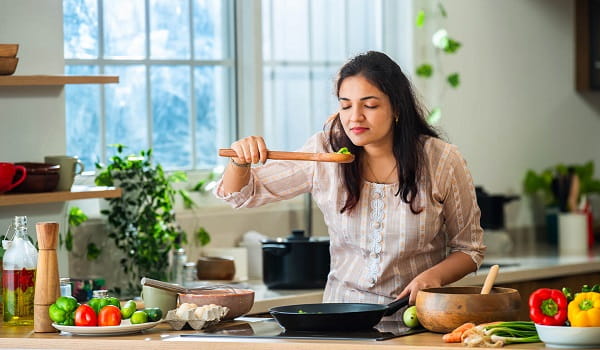
Cooking for paying customers from a home kitchen is the single most accessible and most reliable business for women in India, and in 2026 it has become more structured than ever. The cloud kitchen model — accepting orders via WhatsApp and Zomato, preparing food in your home kitchen, and arranging delivery through Dunzo, Porter, or a neighbourhood delivery person — brings professional food business infrastructure to anyone with a clean kitchen, good cooking skills, and FSSAI Basic Registration.
The economics are genuinely attractive. A tiffin subscription of thirty customers at Rs. 3,000 per month generates Rs. 90,000 in monthly revenue. Food costs for a well-planned menu run 30 to 40 percent of revenue, leaving Rs. 54,000 to Rs. 63,000 before delivery and packaging costs. A home cook who builds this customer base within six months of consistent quality and reliability is running a business that earns more than most entry-level corporate salaries without leaving the house.
The differentiation that works in 2026 is not just good food — it is a consistent, personal style. A home cook who posts daily food photographs on WhatsApp, remembers her customers’ dietary preferences, includes a small handwritten note in festival orders, and responds quickly to feedback builds a loyal subscriber base that defends itself against competition through genuine human connection — something no commercial cloud kitchen can replicate at scale.
2. Online Tutoring and Academic Coaching
Estimated startup cost: Rs. 10,000 – Rs. 50,000 Monthly earning potential: Rs. 25,000 – Rs. 1 lakh
Women who have a strong educational background in any subject — mathematics, science, English, Hindi, social studies, music, dance, or a foreign language — carry a commercially valuable skill that translates directly into an online tutoring business with almost no startup cost. The shift to online learning infrastructure triggered by the pandemic years has permanently normalised paying for remote tutoring sessions, and platforms like Zoom, Google Meet, and the growing catalogue of Indian ed-tech marketplaces have made student acquisition straightforward.
The two most commercially productive models in 2026 are one-on-one tutoring for school students (Rs. 500 to Rs. 1,500 per session depending on grade level and subject) and small group batch coaching of six to eight students at Rs. 2,000 to Rs. 4,000 per student per month. The group batch model scales the hourly earnings dramatically — a batch of eight students at Rs. 3,000 each generates Rs. 24,000 per month from one daily hour of teaching.
Building the first fifteen to twenty students comes primarily through neighbourhood WhatsApp groups, building society notice boards, and personal referrals from the initial students. The quality of teaching does the marketing. Parents who see their child’s grades improve become the most effective and most cost-free source of new student referrals.
3. Handmade Products and Artisanal Business
Estimated startup cost: Rs. 20,000 – Rs. 1 lakh Monthly earning potential: Rs. 20,000 – Rs. 70,000
India’s urban consumers in 2026 are actively seeking handmade, artisanal, and personalised products as gifts, home décor, and personal accessories — driven partly by pandemic-era appreciation for local craftsmanship and partly by a broader cultural reaction against mass-produced, generic merchandise. This cultural shift has created a strong commercial market for women who make high-quality candles, jewellery, embroidered textiles, hand-painted pottery, personalised gifts, natural skincare products, macramé, or crochet items.
The product categories with the strongest current demand are personalised gift items (custom name jewellery, engraved photo frames, hand-stitched keepsakes for weddings and birthdays), natural and handmade skincare (face scrubs, body butters, herbal soaps using clean ingredients), and home décor (hand-painted pots, macramé wall hangings, decorative candles). What these categories share is a story that the maker can tell — the ingredients, the process, the intention behind the product — and this story is the primary marketing asset.
Instagram and WhatsApp are the two primary sales channels for home artisans in India. An Instagram profile with 2,000 to 3,000 genuine followers who regularly engage with a maker’s content generates sufficient order volume to build a full-time income. The investment in getting there is consistent product photography, honest storytelling about the creation process, and genuine engagement with the community that develops around the work.
4. Social Media Management and Digital Marketing
Estimated startup cost: Rs. 10,000 – Rs. 30,000 Monthly earning potential: Rs. 30,000 – Rs. 1 lakh
India’s 65 million MSMEs collectively represent an enormous and largely unmet demand for social media management. Every neighbourhood restaurant, boutique, salon, coaching centre, and small business knows it needs to be on Instagram and Facebook in 2026. Very few of them have the time, skill, or confidence to manage it themselves. A woman who understands Instagram and Facebook algorithms, can write engaging captions in Hindi or English, can create basic Canva graphics, and can run simple Meta advertising campaigns earns Rs. 8,000 to Rs. 20,000 per client per month from three to five clients — entirely from home.
The startup requirement is deliberately minimal. A Canva Pro subscription (Rs. 3,999 annually), Meta Business Suite access (free), a basic understanding of content planning, and two to three free or affordable online courses covering Meta Ads fundamentals is the entire investment. The first two clients come from existing personal and professional networks — a local restaurant, a neighbourhood tuition centre, or a friend’s small business that needs help. These initial clients become the portfolio that attracts subsequent clients at higher rates.
The income ceiling on this business is genuinely high. A social media manager who adds video editing to her skill set — even at a basic Reels production level — can charge Rs. 20,000 to Rs. 40,000 per client per month and sustain three to four clients comfortably from a home desk.
5. Home Salon and Beauty Services
Estimated startup cost: Rs. 50,000 – Rs. 2 lakh Monthly earning potential: Rs. 30,000 – Rs. 1 lakh
A home salon is one of the most consistently profitable home businesses for women with beauty service skills, and in 2026 it carries a competitive advantage that neither parlour chains nor in-home service apps can easily replicate: privacy, personalised attention, and the trust that comes from a known individual rather than a rotating roster of strangers. Female clients who value discretion, who are uncomfortable with the public environment of a commercial salon, or who simply prefer the relaxed atmosphere of a home setting are a growing and commercially significant customer segment.
The service range that works best from a home salon covers threading, waxing, facials, bridal makeup, mehendi, and nail art — all of which require relatively modest equipment investment and can be priced at 20 to 30 percent below commercial salon rates while still producing strong margins because the home setup eliminates rent, staff costs, and commercial overheads. A home salon with twenty to thirty regular monthly clients across these services generates income that is both meaningful and defensible through the personal relationships that keep clients returning.
Frequently Asked Questions
Q: Do home-based food businesses need FSSAI registration?
A: Yes — any food business serving paying customers, including home tiffin and cloud kitchens, requires FSSAI Basic Registration at a minimum. This costs Rs. 100 per year and is applied for online through the FSSAI portal. It is a straightforward process that should be completed before the first commercial order.
Q: Are there government schemes specifically supporting women entrepreneurs in India?
A: Yes — PM MUDRA Yojana’s Shishu and Kishor categories, the Stand-Up India scheme for women SC/ST entrepreneurs, Mahila Udyam Nidhi, and the Udyogini scheme all provide preferential financing and support. Udyam MSME registration also unlocks access to these schemes.
Q: How long does it take to build a home business to Rs. 50,000 per month?
A: With consistent effort, most well-executed home businesses reach Rs. 30,000 to Rs. 50,000 per month within six to twelve months. Tiffin services and tutoring can achieve this faster — within three to four months — because of their daily recurring revenue structure.
Q: Can a home business be run alongside full-time homemaker responsibilities?
A: Yes — this is precisely why home businesses suit many Indian women. Tiffin service, online tutoring, and social media management can all be structured around specific hours of the day without requiring a fixed nine-to-five commitment.
Q: Which home business has the lowest startup cost?
A: Online tutoring (Rs. 10,000 to Rs. 20,000) and social media management (Rs. 10,000 to Rs. 30,000) have the lowest capital requirements of the five options above, as both rely primarily on existing skills and widely available free or low-cost digital tools.